K G Subramanyan
About K G Subramanyan
K. G. Subramanyan was born in 1924 in Kuthuparamba, in Kerala, India, and studied economics at Presidency College, Madras. The turning point of his life as an artist came when he visited Santiniketan to study at Kala Bhavan, the art faculty of Visva Bharati University, in 1944, under the guidance of Nandalal Bose, Benode Behari Mukherjee and Ramkinkar Baij. Subramanyan studied there till 1948.
In 1951, he became a lecturer at the Faculty of Fine Arts in M.S. University in Baroda. He went to study briefly in London at the Slade School of Art as a British Council scholar in 1956. In 1966, he also travelled to New York as a Rockefeller Fellow, where he painted on smaller canvases due to a shortage of space, which led him to experiment with diptychs and triptychs.
In 1980, Subramanyan went back to Santiniketan to teach painting at his alma mater, Kala Bhavan, Visva Bharati University. He continued until he retired in 1989, when he was made Professor Emeritus of Visva Bharati University.
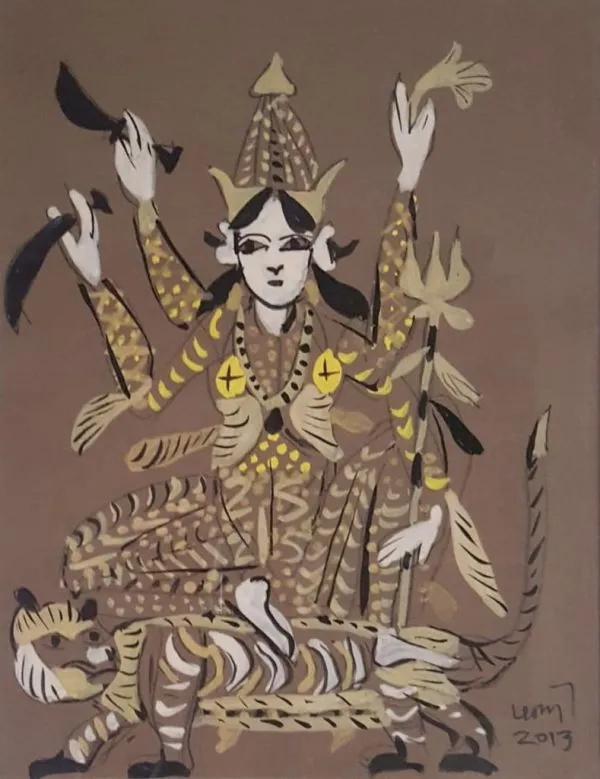
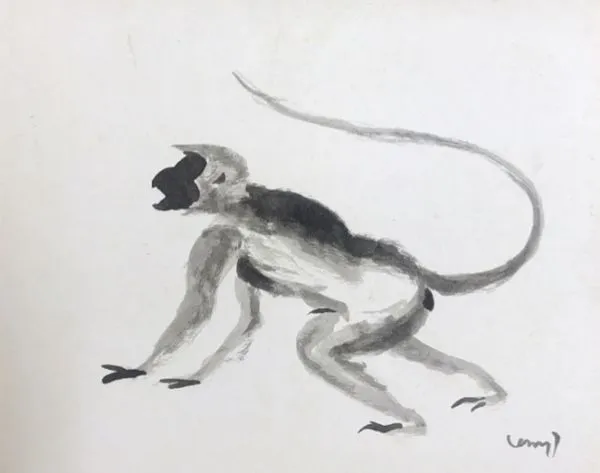
His visual language combined a variety of elements, such as the principles of European Modernism and folk expression. He was known as a painter, muralist, sculptor, printmaker, set designer and toy maker. Subramanyan's works from the late 1940s reflected the influence of his teachers at Santiniketan. Subramanyan later reverted to small-scale works on acrylic sheet, revisiting his favourite themes of brilliantly coloured interiors, domestic animals and brazen women, to which he added Christian mythology and contemporary politics.
He received the Kalidas Samman in 1981, the Padma Shri in 1975, and the Padma Vibhushan in 2012. Towards the later days of his life, Subramanyan resided in Baroda with his daughter Uma, and he passed away there in 2016.