Chittaprosad Bhattacharya was a socialist and a self-taught anti-fascist artist. He was an active, card-holding member of the Communist Party of India (CPI) and its most prominent artist-reporter. His pen-and-ink sketches of famine-stricken villages, emaciation and displacement became a dominant visual record of that suffering, and circulated nationwide in CPI journals, at political meetings and demonstrations, with the travelling Cultural Squads of the Indian People’s Theatre Association (IPTA), and in famine exhibitions held to build awareness and raise funds. He chose materials and techniques that let him produce prints and posters cheaply for rallies, Party meetings and strikes, which kept him outside the Bengal School’s position in the art establishment. He opposed Brahmanical caste hierarchy throughout his life and never used his surname as a form of protest, rejecting the Bengal School’s academic practice, which he associated with colonial patronage. Chittaprosad’s art, writing and visual reporting form an early example of Socialist Realism in Indian graphic art. His political commitment to social realism centred on hunger and destitution, and on the relationship between art, popular resistance and active politics.
He was recruited by the CPI’s General Secretary, P. C. Joshi, into the party’s headquarters in Bombay, then the centre of its Culture Front, alongside artists, performers, photographers and writers. He became part of the Anti-Fascist Writers’ and Artists’ Association and the Indian People’s Theatre Association, and travelled widely documenting peasant movements, workers’ strikes, peasant conferences, political agitation and, above all, the Bengal Famine of 1943. He walked through the hunger-stricken streets of Calcutta, sub-divisional towns and famine-hit villages in the Midnapore district, and produced Hungry Bengal: A Tour through Midnapore District, one of the earliest examples of visual reportage by an artist in India. It stands as an important testimony from the famine years.
Most of Chittaprosad’s works are in black ink and brush or pen, or carved as wood or linocuts. He also worked in watercolour, pastel and oil, on paper and canvas. The starkness of the images reflects his engagement with crisis, translating his sense of social rupture into stark, distorted bodies that brought a form of grotesque realism and social consciousness into Indian art.
De Boer writes of Chittaprosad: “His images take you on an accelerated journey into the epicenter of the revolt that started with the Mutiny and would have exploded into revolution had the colonists not withdrawn. As a colonial administrator I would have looked at these images with fear - sensing that the game was over.”
Chittaprosad is known mainly for his famine sketches, but his post-famine work deserves attention too, since it records the political scenarios of the postwar period. As the freedom struggle entered its final stage, the CPI sought to present itself as the organiser and agitator of the masses, above sectarian politics, and set its targets on the colonial government, the Indian princely states, nationalist politicians, the British and native bourgeoisie, merchants and black marketeers. This produced images drawing directly on Socialist Realism: one of Chittaprosad’s paintings for the People’s Age tabloid shows a worker holding a graph of economic growth and a peasant woman holding sheaves of harvested paddy, while princes, moneylenders, merchants, police and army are driven from the frame along with a hovering skeleton.
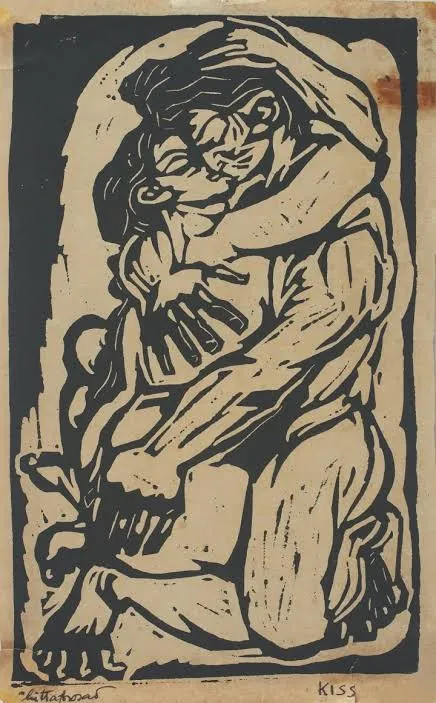
The lovers in this image are ordinary working people, their bodies large and solidly built. Chittaprosad gives them the vitality and passion of the working class; the woman’s desire is her own, openly expressed.
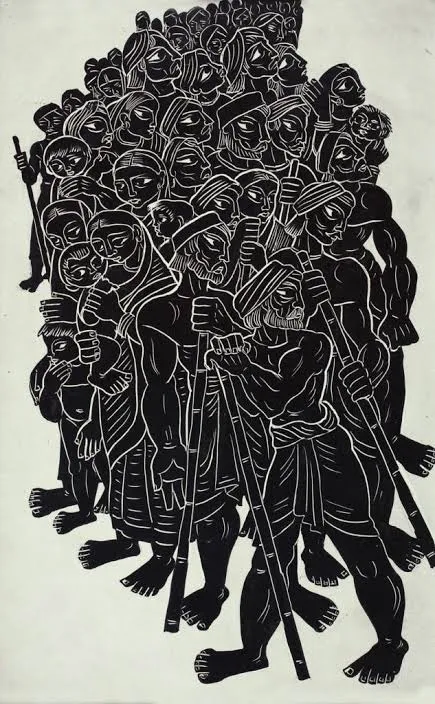
Working-class men, women and children gather in a cluster that reads as a single, unified body, embodying the strength of a united working class.
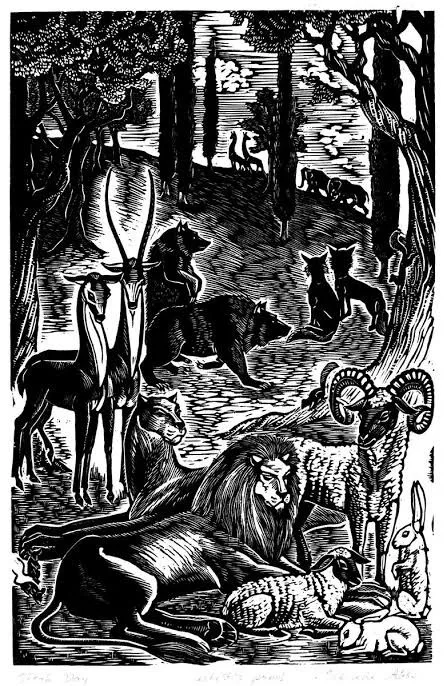
The animals in this forest coexist in harmony, without the hierarchy of the food chain; they live at peace in pairs. The image reads as Chittaprosad’s vision of an ideal, non-hierarchical socialist society.
Despite this substantial contribution to graphic art in India, Chittaprosad and the other Party artists went largely unrecognised in mainstream Indian art history, seen at best as ‘Communist propaganda’. Even critics within Party circles saw the work chiefly in terms of its immediate, transitory use. Literature and performance carried the Left’s project of taking art to the people further; the Party artists’ posters and sketches were reduced mostly to their functional, propagandist purpose.
After independence, Chittaprosad left the CPI over disagreements with the party’s new direction and retired to Bombay, living in a small room on the city’s outskirts with little financial support from the Party. He continued to work, gaining some international recognition through exhibitions in East Germany, Czechoslovakia, Hungary and the United States. He spent much of his later life illustrating children’s books, staging small shows with his own puppets, and producing a series of linocuts on child labour. His direct political work stopped appearing in print, though he continued to make cartoons critiquing the new government of independent India, and took part in the World Peace movement. His comrades remembered him as a committed artist with a romantic, unconventional temperament.
Chittaprosad remained largely unrecognised during his lifetime; the Lalit Kala Akademi, India’s national academy for the arts, brought out the first monograph on him only in 1993.
“To turn my brush into as sharp a weapon as I could make it”
Chittaprosad — artist, socialist, anti-fascist, storyteller and romantic.
