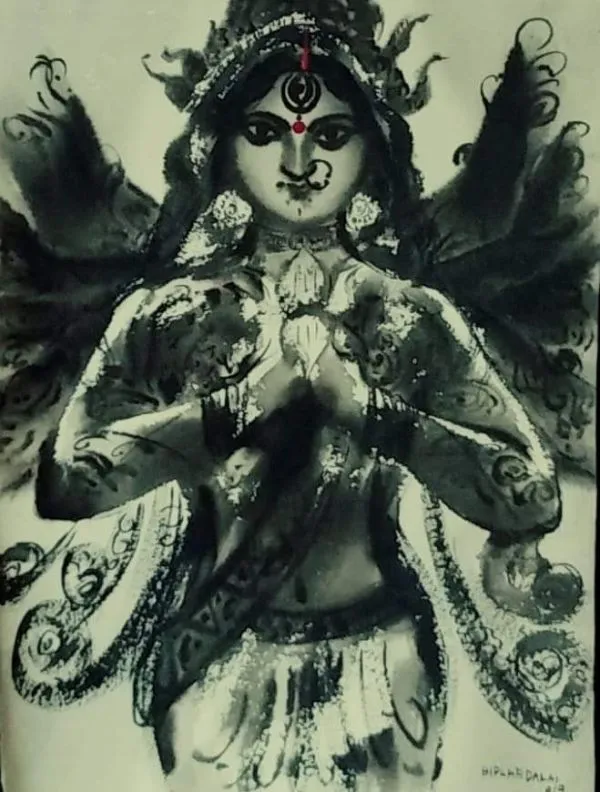
The image and concept of Goddess Durga is deeply entrenched within the heart of India, especially in Bengal. From the terracotta temples at Bishnupur to the temples at Hoysala, from Rajput miniatures to the Kangra school, from the Kalighat paintings to the early Bengal oils, artists for centuries have been drawn to the iconography of the ten-armed goddess.
The name of Goddess Durga is derived from the Sanskrit word 'durg,' which means fortress or castle, denoting something mighty or highly inaccessible. The goddess is first mentioned in the 'Devi-Sukta' of the Rigveda; however, as a deity, she appears in the 'Taittiriya Aranyaka.' Her presence is also found on the coins of Chandragupta I, who reigned from around 319 to 335 AD. Similarly, she appears on the coins of Kanishka of the Kushan dynasty.
The idea of Durga gradually evolved from the concept of motherly protective power that has been nourished in ancient civilisations since the beginning of time. In Indian civilisation, this deity has been expressed in various forms. At times, she is seen as 'Mahishasuramardini'; at times, she appears as Bhadrakali, Jagaddhatri, or Parvati, all different expressions of the same 'Shakti.' In pre-modern Indian art, there is a variety of expressions of Durga in the Kalighat Patachitras and the Early Anonymous Bengal Oils. In the early Bengal oils, most of the images of Durga are mythical, depicting the goddess as she is worshipped in Bengal during a particular period of the year. The Kalighat paintings, however, show a wider variety of expressions of the Goddess.
Myth and daily life blend to form a unique visual synthesis. Images show Shiva in his conventional attire taking a walk with Ganesh in his arms, while Durga or Parvati walks beside him, extending her hands toward the child, wanting to take Ganesh in her arms. This merging of the divine with a commonplace activity like an evening walk was unique to the Kalighat School, which flourished near the temple vicinity and was patronised by the British. This was just one example of how the iconography of Durga has been treated in Indian art, both pre-modern and post-modern. In Bengal, two distinct manifestations of the Goddess emerge: one mythical, a source of power, and the other worldly, depicted as a daughter, bride, or mother within the family.
In the paintings of the Neo-Bengal School, Goddess Durga has been depicted by various artists in different forms and manifestations. A watercolour by Gaganendranath Tagore shows the immersion procession of Devi Durga, executed in a Japanese wash method, with divine light emanating from the image of the Goddess. This image differed from the contemporary depictions by other artists of the Neo-Bengal School. Most of Nandalal Bose's depictions were classical in form and linear in rhythm. Jamini Roy's depiction of Durga stood apart from any other artist of the Bengal School: he assimilated folk simplicity and sobriety with modernist sophistication. His Goddess is mostly depicted as the 'Eternal Mother,' the mother of the popular spirit of Bengal. 'Ganesh Janani' was his preferred theme. Ramkinkar Baij returned often to the Goddess, in both his paintings and his sculpture.
To the artists of the early 1940s, the basic image and concept of Durga marked a departure from what was considered 'traditional'; it underwent radical changes. These artists depicted and transformed the image through an assimilation of traditional Indian motifs along with Western modernist forms. The works of Nirode Mazumdar, Paritosh Sen, Shanu Lahiri, Abani Sen, and Sunil Madhav Sen provide ample examples of such a departure. The works of Nirode Mazumdar, in particular, stand out, as he combined elements of tantra and expressionism to arrive at a unique style. This East-West synthesis took complete shape in the works of artists who emerged in the late 1950s. The Kalighat School was a source of inspiration for Bijon Chowdhury. Prokash Karmakar, who returned from Paris, broke his forms apart in the light of Western expressionism.
From the 1960s, artists like Ganesh Pyne emerged with a different approach. The image of Durga was a favourite theme; he drew her in her traditional form. Divinity and mythical inwardness were essential features of his Durga, and he never deviated from it. Bikash Bhattacharjee, in his 'Durga' series, brought the divinity of the Goddess down to an earthly level. For Bikash, every woman was a manifestation of Durga: when they suffered, the eternal divinity suffered; in their celebration of life and motherliness, the divinity, too, was present. Bikash Bhattacharjee brought myth and the mundane together within a single image. By placing the third eye on his women, he endowed the common womenfolk with a sense of godliness.
Jogen Chowdhury depicted Durga from a rebellious standpoint, in distorted and expressionist forms, while for Sakti Burman the Goddess descends from heaven onto earth to play with children amid lush and fantastic gardens; Burman heightened Western classicism with Indian mythology. In Arpita Singh's work, Durga often appears with a pistol in hand, ready to confront the urban criminals who threaten life to the point of destruction.
The form and the way of interpreting the Goddess have changed with the passage of time. The post-modernists and the proponents of conceptual art of the 1990s used the image with irony and rebelliousness in their installations and video art, pushing the convention toward a super-real register. Since the early centuries of Indian civilisation until the present era of conceptual art, Durga, the fierce warrior Goddess, has played a continuous role in the life and art of the country. This 'power' has been a motivating force across that art.
- Vinayak Pasricha