Prokash Karmakar (1933-2014) lived in the city of Calcutta for most of his life and contributed to modern and postmodern Indian art through the second half of the 20th century and the first decades of the 21st.
He was born to the artist Prahlad Karmakar, who taught painting at the Government School (later College) of Art & Craft, Calcutta. At a time when the Directorate of Public Instruction, following Victorian ideas of sexual morality in British India, would not allow nude study in art institutions, Prahlad arranged nude classes in his own studio, and students from the art school came for them every evening. Young Prokash grew up in this intellectual and artistic atmosphere. A year before Independence, Prahlad died. At the age of thirteen, Prokash joined the defence party. During the clashes and the Calcutta killings, a group of thugs broke into his father's studio one night, tore Prahlad's paintings from the wall and set them on fire. The incident angered Prokash and left a lasting mark on him.
At the age of fourteen, Prokash found himself in a poverty-stricken family; his mother fell ill and soon passed away. He joined the Government College of Art & Craft, but with hardly any money he struggled for two years and found it difficult to continue his studies. In between, he worked in a block-makers' workshop, subsidising his income with book cover design and illustration. For a couple of years he drifted, working hard to keep his head above water. He then joined a large chemical firm producing indigenous medicine, where he rose to become art director; for him, permanent employment was a promise of security.
Still, he longed to paint in his spare time. Kamalaranjan Thakur, once a student of Prahlad Karmakar, began teaching him the techniques of transparent and opaque watercolours. Around 1959, after this brief coaching with Thakur, he joined Dilip Dasgupta's studio. Here, before and after office hours, he concentrated on learning instant sketching, life drawing and the use of other mediums such as oils. The other members of the group — Karuna Shaha, Arun Bose, Sanat Kar, Santosh Rohatgi and Sukanta Basu — were further along, as they had not dropped out of art school as he had. Competitive by nature, he worked hard to close the gap.

Kali, by Prokash Karmakar,1999.
In 1959 he held his first pavement show on Sudder Street, on the railings of the Indian Museum, and became known almost overnight. The press took notice, and the largest-circulating Bengali newspaper printed an editorial praising him for bringing art into the open air. It was during this period that he began participating in the newly formed Lalit Kala Akademi.

Prokash Karmakar- Reclining Nude.
As he mastered a variety of mediums and techniques and came to understand the principles of pictorial delineation, he felt the need to experiment with new modes of expression. It was at this point that his friend, the artist Bijon Choudhury, introduced him to Nirode Mazumdar (1916-1982), an established figure in 20th-century Indian art. Mazumdar had returned from France after a twelve-year stay. He had once been a student of Abanindranath Tagore and his Neo-Bengal School, and as a young man had searched out his own roots within it. After his apprenticeship with Abanindranath, he broke away, feeling the school had become a place where students rendered the classics in paraphrase rather than found their own methods. In 1943, he and a few other artists formed the 'Calcutta Group,' which was later instrumental in bringing the tradition of modernity into post-colonial Indian art.
Mazumdar invited Prokash to join his studio and work with him, giving him a thorough grounding in the art of man from the days of cave shelters to more modern times, including work from nude models. He made Prokash aware of forms, substances, concepts and techniques of art, and in effect helped him experiment and discover a personal style. In 1961, Prokash became a founding member of the Society of Contemporary Artists. He later broke away and, with artists including Rabin Mondal and Gopal Sanyal, formed the Calcutta Painters.

Karmakar is remembered for his nudes set against lush surroundings.
In 1966, he won the National Award for painting at the Lalit Kala Akademi's annual exhibition, which put him on the art map of India. Two years later he left for France on a fellowship from the French Government. While in Paris, he exchanged ideas with leading painters and saw their work. He also travelled widely in Europe and spent long hours in museums studying the Old Masters and the Impressionists. Back home, he reworked these European experiences into a style of his own, rooted in Indian forms, with elements of cubism and expressionism recurring in most of his paintings. A born draughtsman, he loved to draw, and drew as much as he painted — even more, at times.
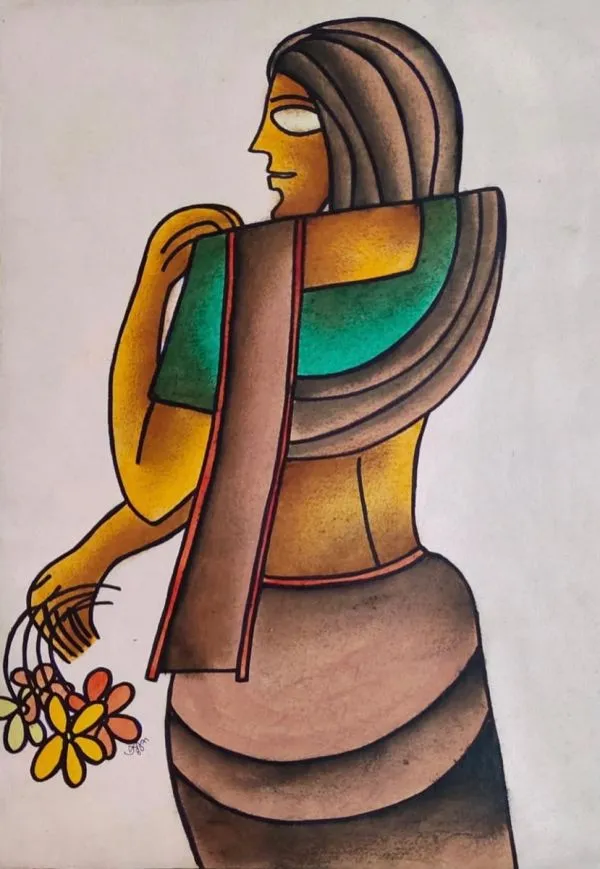
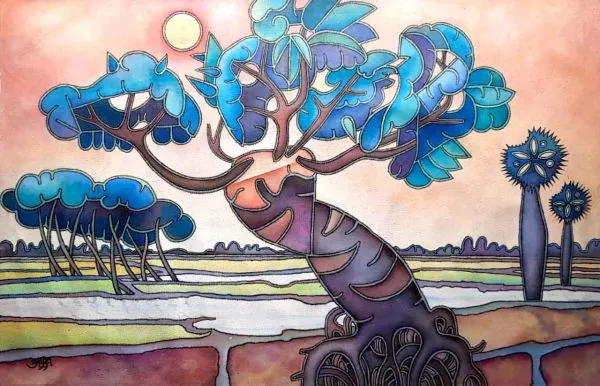
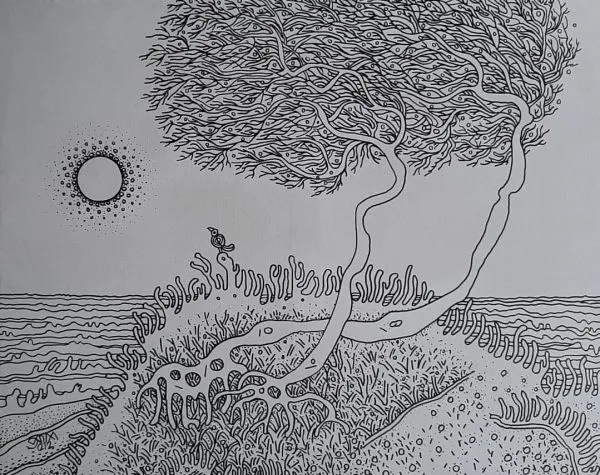
His drawings speak of a sophisticated sensibility as well as a concern for the ordinary man. His lines are firm, with the plasticity and movement of an accomplished draughtsman. His showmanship and humanitarian concern won him a large following, even among those who did not follow art closely. There were definite elements of pantheism in his work. His landscapes — ponds, lakes, streams, crooked yet upright trees, lush tropical vegetation, rugged terrain, the changing sky, the variety of moods found in nature across the cycle of night and day — hint at a world that is by turns harmonious and chaotic, as the one people inhabit.
Prokash Karmakar would feature in any account of Calcutta's art scene. His bohemian lifestyle was copied by younger artists and criticised by the senior section of the city's civil society.
Vinayak Pasricha.