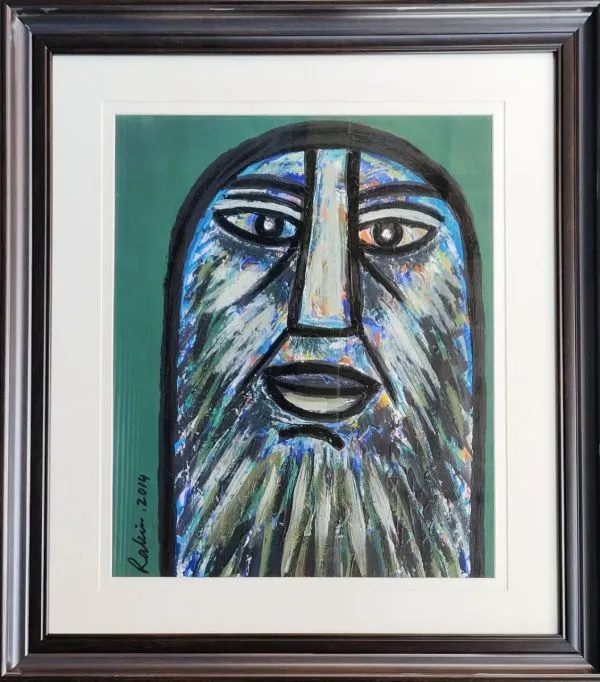
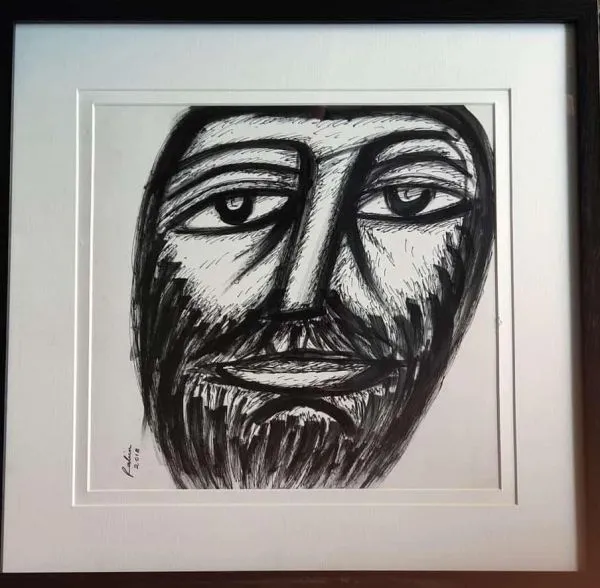
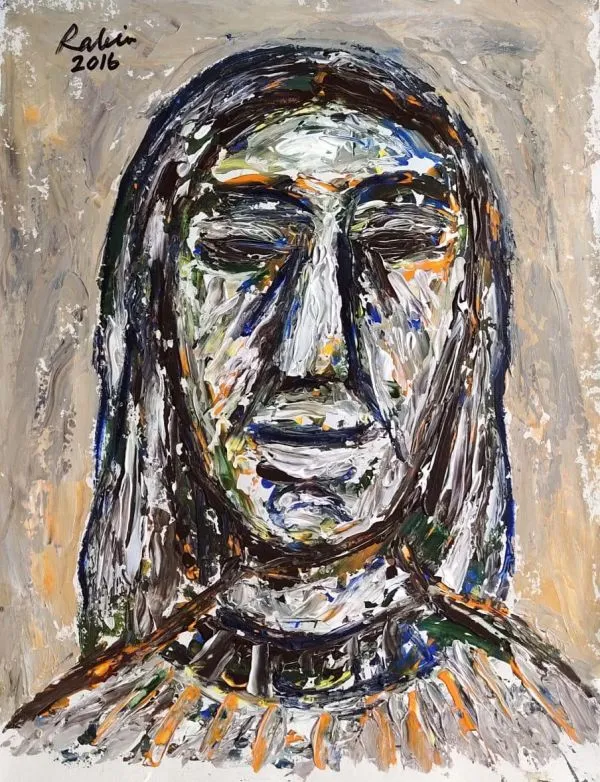
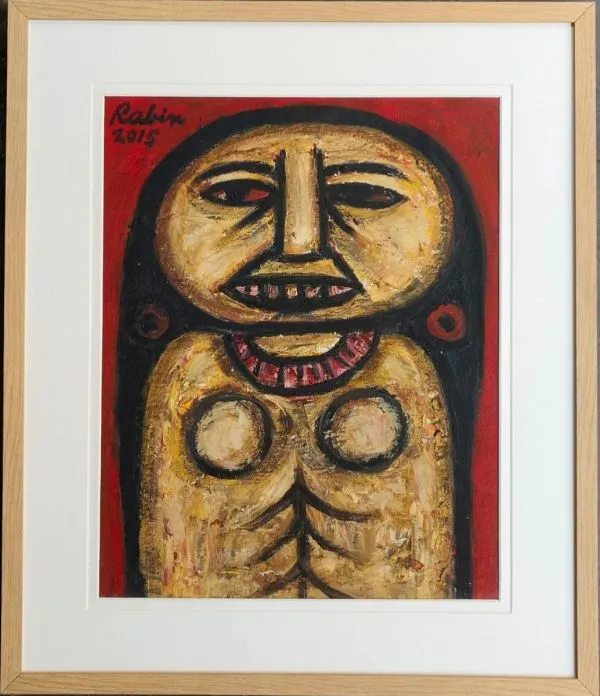
When Rabin Mondal's drawings were exhibited for the first time in the early 1970s at the South Asia Institute, Heidelberg, art historians such as Hermann Goetz and Heimo Rau discerned in them an unexpected quality that was difficult to define. Mondal's earlier paintings were concerned with the group identity of man: people trapped by their destiny, in primal interaction with their surroundings. Strong, intense figures symbolised the grandeur of human effort, yet carried a hidden comment on their elemental faith — a gentle irony over whether this was the final destiny of man, and where it was expected to lead.
His later figures moved away from that group identity, towards a battered isolation, belonging to a strange, silent, undefined world, often detached from the passions of daily life. As Mondal used pure colour to give his subjects a ritualistic aura, the figures appeared stuck in time. The King recurred as a symbol of power, decadence and the will to rule, yet carried, as in Greek tragedy, a pathetic undercurrent of weakness, a concession to human fallibility. His work leaned heavily on primitive symbols and totems; even his figures often stood for an existing yet unseen intermediate relationship. Strangers and lovers alike remained masked, each an island unto itself.
Emerging in the late 1950s, Mondal's world view was existential. Unconcerned with philosophies or traditions of art and aesthetics, he was, like many of his generation, trying to nail his own demons to the surface of the canvas. While some artists turned to the classics for an interpretative parallel to the present, Mondal turned to the brutal protohistoric figure and its vengeful deities. Over the years his main preoccupations were beasts, heads, kings, queens, comedians, whores — a whole gallery of human beings and animals rendered in harsh black lines, pungent reds, shocking blues and mortifying yellows. The human faces in most cases were foreheadless, wrinkled, agonised, often deformed. Born in 1929, Mondal grew up in the industrial town of Howrah, near Calcutta, just across the river. He knew the city intimately, its urban poverty and its growing squalor, and saw at first hand the toll political ideologies took on day-to-day life.

In the 1950s he employed a cubist approach, adopting neither the ahistorical non-space of the Bengal School nor the flat surface of the Kalighat pats. By the late 1950s and early 1960s, his canvases carried a broken and twisted form, progressively simplified and moving towards pure symbol. The distortion became consciously Expressionistic, rendered in contrasting colours, charged with emotion. In the second half of the 1970s, the claustrophobic pictorial space suddenly yielded to a kind of recession, out of which came the King series, built from two contrary images: the hunter and the hunted.
The King and Queen figures who appeared at this time seemed dwarfed by the crushing weight of the dark powers they wielded, looking pathetic and forlorn. This was because Mondal belonged to a generation for which angst was not an abstract philosophical idea but a lived personal experience. Situated in a milieu of dissolving faiths and moral and intellectual confusion, his work takes the viewer into a strange, silent world that asks to be read closely. His real inspiration came from the socio-political turmoil of the 1940s: the Bengal Famine of 1943, the horrors of the Second World War, the communal riots of 1946, and then Partition, along with the influx of refugees that followed, shook the foundations of his outlook.
Those familiar with Rabin Mondal's work found, again and again, that he had steadfastly refused to follow convention. His art was the kind that either overwhelmed a viewer or repelled them. Over seven decades, he subverted classical canons to express angst and rage towards bestiality and decadence, giving his works a nervous, unresolved narrative quality. In its single-minded pursuit, Mondal's art carried an allegorical quality, using colour and pigment to set his figures apart from ordinary humanity. Rabin Mondal stood alone, without predecessors or followers — rare in the world of art.
Archetypal images and archaic forms gave his work a sense of primitiveness, with an affinity to tribal and folk forms. In using them, he brought his paintings a raw vitality, simplicity and freshness. Mondal did not paint the real, yet the essence of reality prevailed in his work all the same.
Vinayak Pasricha