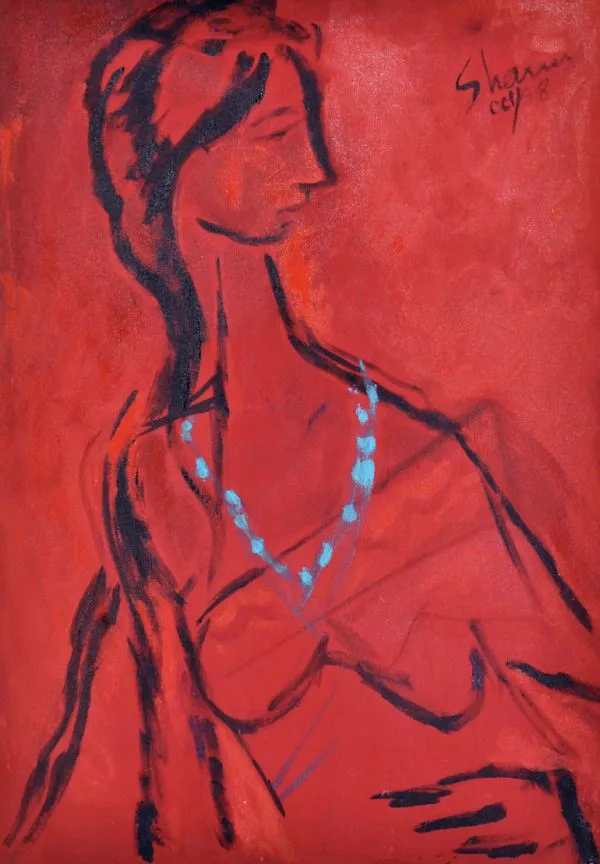
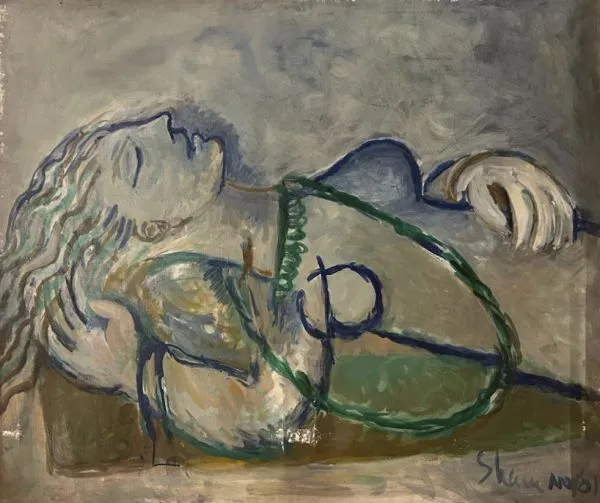
Shanu Lahiri could often be mistaken for someone's grandmother — her hair tied into a bun, a soft face and wise eyes — had it not been for her trademark red apron and a paintbrush in hand. Her art mixed the soft and the definitive: outwardly commonplace, with unexpected undertones. Born on 23 January 1928 into a prominent, culturally active Calcutta family, Shanu was the youngest of seven siblings and the youngest of three sisters in the Majumdar family, an intellectually rich household. By the time she was growing up, her two elder brothers, the writer Kamal Majumdar and the artist Nirode Mazumdar, were already established figures in the city's intellectual and artistic worlds. Kamal Majumdar, admired for his wit and erudition, became known as a "writer's writer"; at the same time, Nirode Mazumdar broke away from the teachings of the Bengal School, rebelled against Abanindranath Tagore, and left his early "oriental" training to become one of the first modernists and a founding member of the new collective called "The Calcutta Group."
In the year of India's Independence, Shanu Majumdar entered The Government College of Art and Crafts, Calcutta, as one of the earliest batches of female students at the institution. This early batch included a number of remarkable women with whom she shared a close camaraderie. A few years her senior, fellow student Karuna Shaha had already made history by tearing down the Union Jack from the college gates during the Quit India Movement and getting herself rusticated. In 1947 she rejoined to complete the last two years of her graduation. Like Shaha, Shanu was a leader of sorts among the small number of women who entered the institution in those years — women who knew they had to outdo their male counterparts to stake a claim to an artistic profession.

Shanu Majumdar (seated in the middle) with the batch of 1947 at the Government College of Art & Crafts, with Atul Bose and Ramendranath Chakravorty behind.
At the art college, she entered at a time when Atul Bose was the principal, and studied under him for a year. Ramendranath Chakravorty followed, and left an abiding impact on her as a student. Basanta Ganguly was another teacher who drilled into the young Shanu the technical aspects of being a good artist. At the art college, she was trained as a draughtsman under the curriculum set by the British colonial system. One of Shanu's greatest challenges was to emerge from the shadow of her brother, Nirode Mazumdar, a shadow that would long hover over her through her own Paris years and for several years after. It is to her credit that she carved out an independent niche for herself while still a student at the Government College of Art and Crafts. In 1950, she set a rare precedent for a student by holding her first solo exhibition of paintings at 1, Chowringhee Terrace, attracting attention in the press, especially for the inspiration she had begun to draw from painters such as Van Gogh and Picasso. The following year, as she graduated in 1951, she sold a painting to the Salar Jung Museum in Hyderabad and won the President's Gold Medal — a first case of a student sharing the honours with a senior artist. In 1955, holding another solo show at Artistry House in Calcutta, a year before her departure on a French scholarship to study at the École du Louvre, where she learnt art history and appreciation, and at the Académie Julian, where she learnt painting. She was already being rated by critics as "an artist qualified to take her place amongst the best of the Moderns." Being fiercely, and consistently, modern was the driving thread of her artistic life, from her student days through the many stylistic phases that followed.

Shanu Lahiri in her studio.
The 1950s were the formative years for the artist, with the highpoint being the two years she spent in Paris, studying and painting, observing and absorbing the work of artists she had long admired, which unfolded before her eyes each time she visited the museum. Like many of her generation, Paris was for her the centre of modernism, and it was the legacy of the French "high modern" that left the most lasting mark on her own innovations with form, colour and composition. While Picasso and Matisse remained for long her clearest points of reference, the art she saw first-hand during those years left many other, subtler traces in her work. Years later, the blackened, brusque faces of Rouault, the animal visages of Chagall, or the "Sleeping Gypsy" of Douanier Rousseau would keep returning in new guises. Breaking free from the strictures of Western academic training and the lingering stereotype of "Indian style" painting was crucial to making the new modernist art of these years.

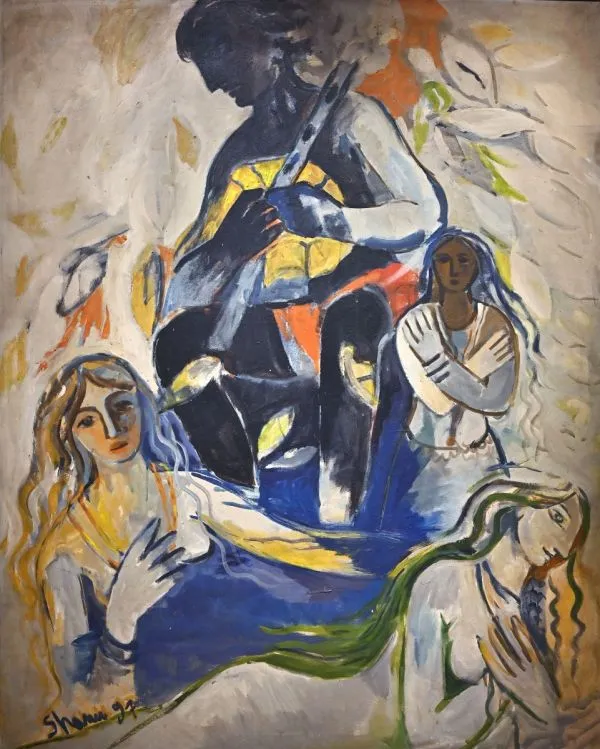
Women by Shanu Lahiri.
The period that followed her return from Paris was one of intense anguish and self-reckoning, a time when she threw away her brushes and palettes, convinced that after all she had seen abroad, there was nothing left for her to do as an artist. In retrospect, she returned to painting in the 1960s, jolted back by news of Karuna Shaha's 1962 solo exhibition, held soon after Shaha's return from the Academy in Florence. This was also when she embarked on the first of the many series that followed. Her "Dream Series" of the 1960s reinterpreted myths and fables, a hallmark of her work through the 1970s and 1980s. One of the most visually striking was her "Ragamala" series of 1978, where the eye is held by her use of colour and where the imagery of each Raga and Ragini of Hindustani classical music carries the resonance of its mood and melody. With her "Thakumar Jhuli" series of 1982, a new genre of densely narrative composition emerged, its restless, macabre figures recalling the fairy tales of childhood. By the late 1980s her work reached a mature point, combining her greatest imaginative energy with the firmest command of her own formal language.

Catalogue cover of the Ragamala series, by Shanu Lahiri.
Large canvases, bristling with life, line, colour, brushwork and splattered faces and torsos, carried a style unmistakably her own. By the second half of the 1980s her work shifted towards a new simplification and economy of form, matched by greater restraint. While retaining their scale, her compositions began to work with a modulated palette, a choice of just one or two colours, and the force of a single contoured image. These effects are best seen in the large body of lone staring faces and seated female figures of these years, and in a series of women on hand-pulled rickshaws — a Calcutta phenomenon, where the dynamism of the lines makes colour increasingly redundant. It was also a time of an increasingly public profile for Shanu Lahiri, as an educationist, organiser and art activist, engaged in a public role through the decade. Following the practice, started in 1975 by Nirode Mazumdar, of artists designing the Durga image at Bakulbagan, Shanu Lahiri designed the idol there twice, working within a clay-modelled image of the goddess as other artists did each year.

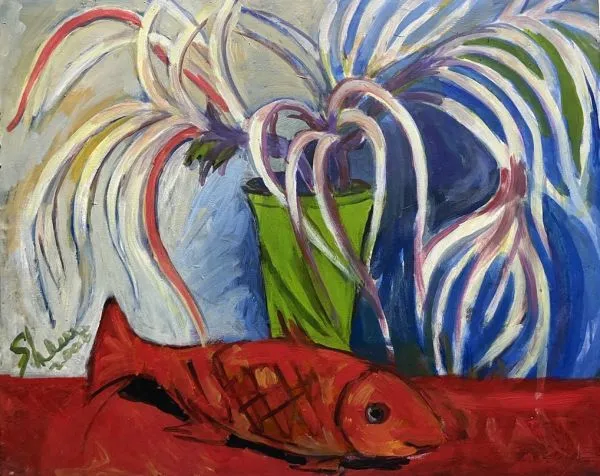
Intense and saturated colours dominated the oeuvre of Shanu Lahiri.
From her position as Reader in the Department of Painting at Rabindra Bharati University, she became Professor and Head of the Department, and then Dean of the Visual Arts Faculty in 1985. Administrative duties never curbed her initiative in creating new kinds of student and exhibiting activities. In 1983, in the middle of these commitments, she became one of the founding members of the city's first working unit of women artists, a body called "The Group," consisting of five members: Karuna Shaha, Shanu Lahiri, Meera Mukherjee, Santosh Rohatgi and Shyamasree Basu. Such an organisation of women became the target of much implicit scorn and condescension in contemporary art circles. The artists remained resolute and unequivocal about the need for such a forum. Women had for long been obscured in their profession, echoing what Virginia Woolf once wrote: "For most of history, Anonymous was a woman." It was in that very identity that the artists had to fight for equal participation and the right to be taken seriously in the art world. Since its inception in 1983, The Group exhibited annually at The Academy of Fine Arts. In 1986 and 1987, the exhibitions travelled for the first time outside Calcutta, to the Triveni Kala Sangam in New Delhi and the Jehangir Art Gallery in Bombay. Such wider exposure was important for the artists. Despite holding exhibitions at regular intervals, sales were disappointingly rare; a different approach to marketing and promotion would have helped, and brought greater engagement with more modern and avant-garde art trends.

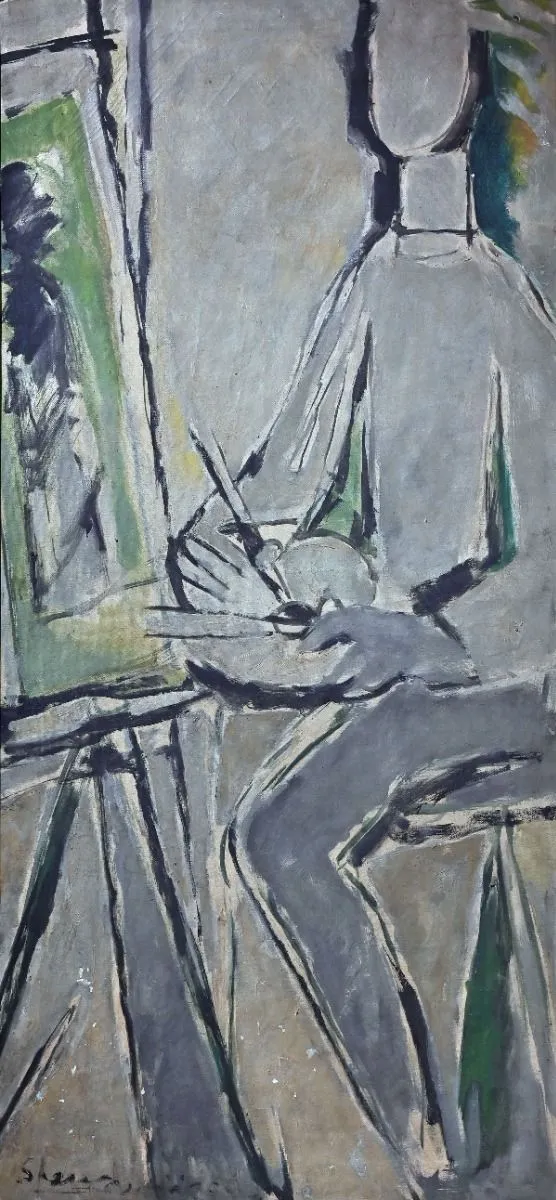
Shanu Lahiri at work.
Even more significant during these years was her involvement with public art projects across the city's walls, streets and parks. Her "Love Calcutta" project involved school children, vendors and slum dwellers painting their own murals on walls across the city, alongside open-air sculptures she set up in metal, concrete and fibreglass. That today hardly any of her murals or sculptures, such as Parama, survive is a comment on the neglect of the city's public culture. In the 1990s and 2000s, her studio was a place of continued inventiveness and innovation. Retaining her primary commitment to painting and drawing, she tested new mediums and surfaces, experimenting in distinct phases with enamel painting on acrylic sheets, painting on wooden and ceramic plates, etchings on X-ray plates, and "torch light" drawings on bromide paper. A parallel interest in sculpture led her from small clay models to figures cast in bronze from perfume bottles. Through her art, Shanu Lahiri addressed the realities of her society.

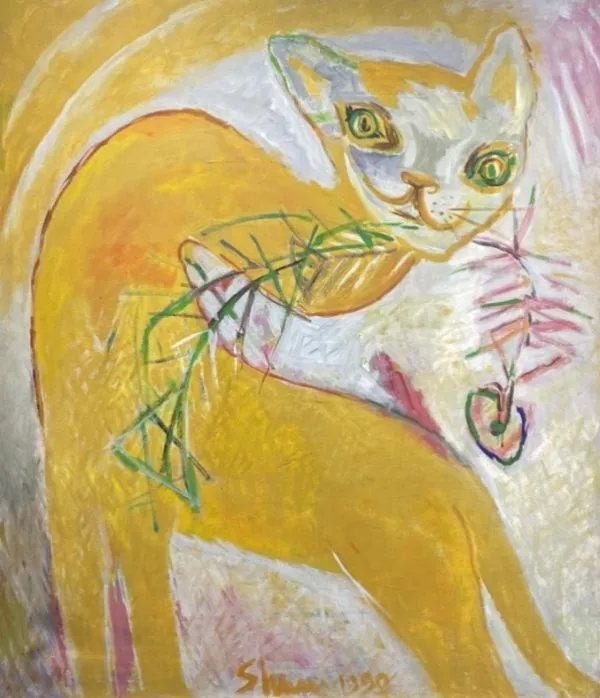
Cats by Shanu Lahiri, 2002.
Alongside her continued preference for large canvases, for the challenge of scale, Shanu Lahiri showed no sign of slowing down. Her energy remained unflagging. Where, then, does Shanu Lahiri belong in the history of India's modern art? It is hard to narrate the history of artists who cannot be placed in the first rank, who find no place even within the national canon of "women artists." While her generation marked the first entry of women into art schools across the country in the 1940s, it also marked the first conscious attempts by women to break into a public sphere and build their own artistic careers. The reductionist view that only a few artists have value is a misrepresentation of the sheer talent and creativity of hundreds of artists. This narrow view of India's artists raises only a few to prominence, while others die without recognition. Academic research on Indian art remains limited, institutions underdeveloped and archives under-resourced. It is no small irony, then, that Shanu Lahiri received so little national publicity, or a proper account of her life and work, when — like many of her generation — she remained committed to her practice for more than sixty years without ever entering the national mainstream.

Ragamala by Shanu Lahiri, 1978.
Vinayak Pasricha.