Suhas Roy (1936–2016) received his diploma in painting from the Indian College of Art and Draughtsmanship, Calcutta, between 1953 and 1958. During this period he took part in the International Youth Art Exhibitions in Czechoslovakia.
In 1965, on a French government scholarship, he went to Paris and enrolled at S.W. Hayter’s Atelier 17 to learn graphic art, and studied mural painting at the École nationale supérieure des Beaux-Arts. The flexible schedule left him hours to spend in the city’s museums. The exposure moved him from Rubens and Ingres to the Impressionists — Monet, Manet, Sisley, Renoir — and their methods of capturing natural light with bold, impulsive strokes. Their handling of light and shade struck him with a new sense of wonder, though he was already drawn to the human figure.
During these museum visits, Suhas sought out the lesser-known painters he had admired through prints in Calcutta. Roy consciously shifted from landscape painting to portraiture. He understood that the easiest way to hold a viewer’s attention was a well-rendered face, so rather than working as a conventional portraitist he settled on one particular type of female face.
He had been adept at portraiture from the beginning: the small sketches of his college colleagues and friends in Calcutta, and the hasty studies of faces and gestures he made in Paris and on his travels in Italy, show his control of the genre. After his long spell with landscapes, he was searching for an alternative, and the same intensity returned in his portraits of women, which he called Radha.
The format carries the same mystic quality as his landscapes, though the palette became simpler. To describe Suhas Roy only as a narrative painter would minimise the scope of his work. Radha is a prototype rather than a portrait: a still, sculptural face that communicates little beyond itself. Looking at her, a viewer finds she does not reciprocate attention or commit to it. Some narrative element is unavoidable, given the scale of the myth that surrounds this figure.
In the Vaishnava tradition, Radha is a divine figure, consort to Krishna, portrayed in endless lilas with her beloved. Passionate and sensuous, she flirts, waits for him to appear, meets him, and offers herself to him in body and soul. She is a character full of contradictions, yet also part of the Hindu pantheon at every stage of life and history, and a lasting source of inspiration. Her restless longing for Krishna is reflected in her bearing, her gait and her tenderness.
It would have been easy for Roy to draw on the written material about Radha and Krishna and start a series from there. Instead, he took the harder path of seeking his own stream of consciousness. At first he followed the popular myth and decorated his early Radhas with elements drawn from it, and the shift toward purely human forms came slowly. The myth was the true inspiration, and by chance his passion found its correlative in Radha; to him, a woman was already a mysterious form. He felt that adding Krishna or the other gopis to the composition would be redundant, since his sole intention was a passage into the ideal through a single female face and body. Radha became a pattern that filled the eye, remote yet resonant. A sense of remoteness haunts the figure, and with so little said on the canvas, an entire journey is implied.

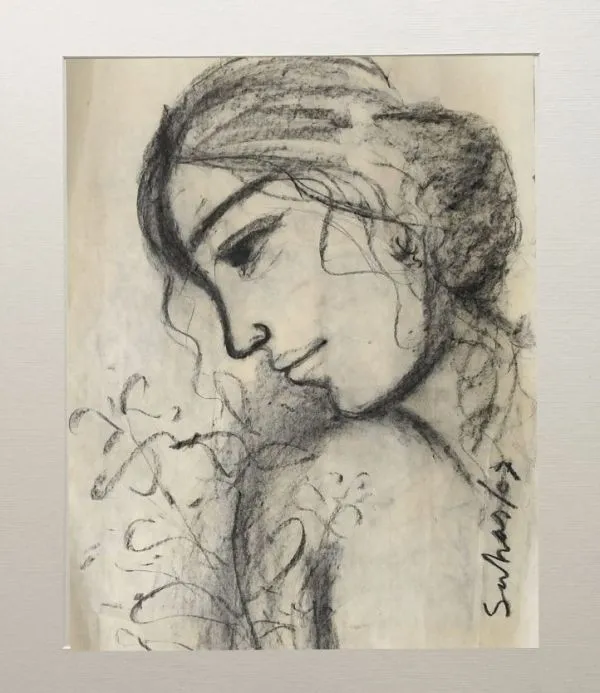
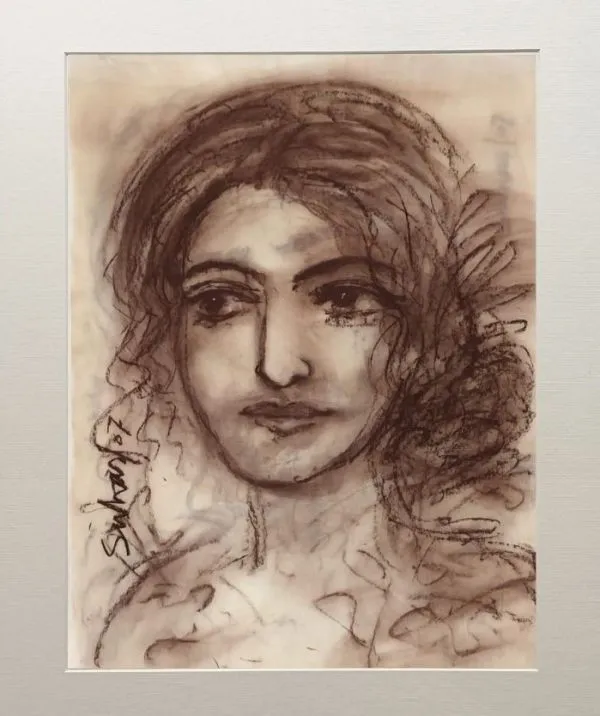
Radha by Suhas Roy.
The idea was to carry the viewer to another place, away from the tedium of daily life. Roy often referred to the women painted by England’s Pre-Raphaelites, such as Rossetti and Waterhouse — Waterhouse’s The Lady of Shalott sits in a canoe, bound for the many-towered Camelot, and whether to read her as dead or alive is immaterial. At least some of Roy’s Radhas carry the same unearthly quality; his mystical women drew the viewer toward a state where nature and woman occupy the same plane. He reached this through a demanding textural process, most of the works done in tempera, the medium that suited him best. Layers of colour, mostly monochromatic, built up what was almost a visual riddle, out of which the face emerged, with highlights on the forehead, the chin, the nose and the hairline building the sensitivity of the image.
Suhas was not hesitant to call his Radhas descendants of the women painted by Da Vinci, Raphael, Indian miniaturists and the Pre-Raphaelites. Roy’s Radha is a solitary figure, and he was confident that no two were alike, though a viewer might still group them as decorative, domesticated or youthful. In the decorative pieces, the influence of Rajasthani miniature painting is prominent — the jewels, the headgear, the tiara, the nose ring, all adding a certain luminous quality.
The domesticated Radhas wear a simple, everyday look — hair unarranged, the face without make-up, the gaze fixed somewhere beyond the frame. These come closer to the middle-class women of Bengal. Suhas Roy’s Radhas became, in this way, an image of an ever-flowing life cycle, where poise, peace, beauty and grace hold together.
Vinayak Pasricha