Lalu Prasad Shaw trained at the Government College of Art & Craft, Calcutta. As a child in Siuri, Birbhum, before that training, he watched his mother make alpona patterns on the floor of their house, and these early years spent alongside her shaped his interest in drawing. Near their house, the Malakars — rural craftsmen who made idols and the patas placed behind them — worked; Shaw was drawn to this work from a young age, and it gave him his first ambition to become an artist.

Lalu Prasad Shaw at Work.
Recreating the chalachitra patterns on the idols made by these folk artisans, and the floral designs worked into more elaborate pieces, gave Shaw the quiet strength and delicacy that would later mark the paintings and prints he made as a student at Calcutta’s art college.
Shaw’s first art teacher was Pinakinath Bhattacharya, who taught at the local school. He was passionate about art as a boy but did not then think of it as a profession. He read Bengali magazines such as Prabasi, Basumati and Modern Review, and taught himself by copying the illustrations printed in them.

Flower Vase by Lalu Prasad Shaw.
In 1953 Shaw was admitted first to the Indian College of Art and Draftsmanship, Calcutta, but left within months and joined the Government College of Art and Craft, Calcutta, in 1954. It was there that Shaw learnt the difference between an artistic mind and mechanical repetition, and found he could not work to fixed technicalities. Ajit Gupta was his favourite teacher in his first year; Shaw often visited his house on Sundays to learn tempera technique, an influence still visible in his tempera work. In his second year he studied under Gopal Ghose, Rathin Maitra, Anil Bhattacharya and Maniklal Bandopadhyay.
Like most artists of his generation, Shaw was familiar with the Impressionists and Post-Impressionists during his college years, but wanted to move past his formal training; he began working in abstraction, breaking free of fixed forms, and through the 1960s experimented with keeping a picture’s two-dimensionality. In 1967 he joined the Society of Contemporary Artists, where Sanat Kar introduced him to graphic printmaking and Suhas Roy, newly returned from Paris, taught him etching; Shaw devoted himself to printmaking between 1966 and 1973. During this period he also taught at his alma mater under Satyen Ghoshal, and later joined Kala Bhavan, where he took up lithography and tempera seriously. While at Santiniketan he felt drawn back to tempera and wash painting even as he continued printmaking, and from 1983 he worked in tempera alone.

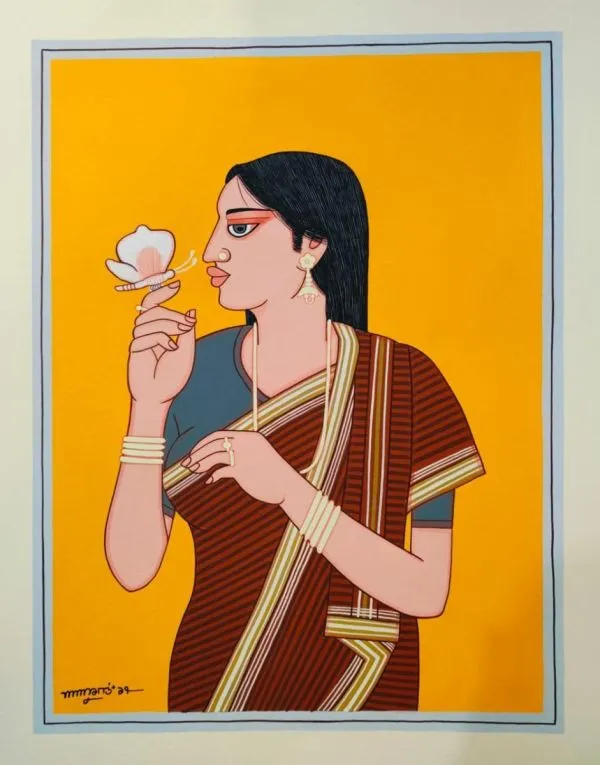
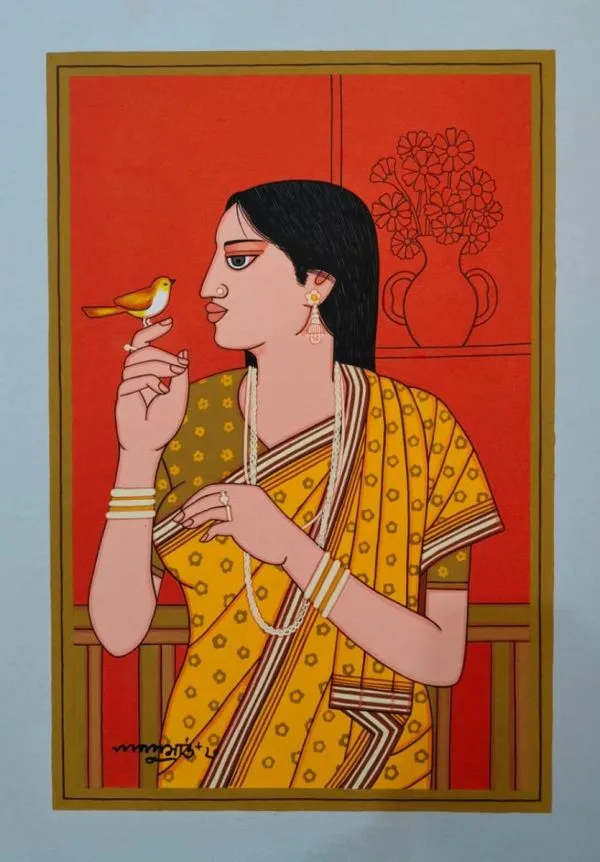
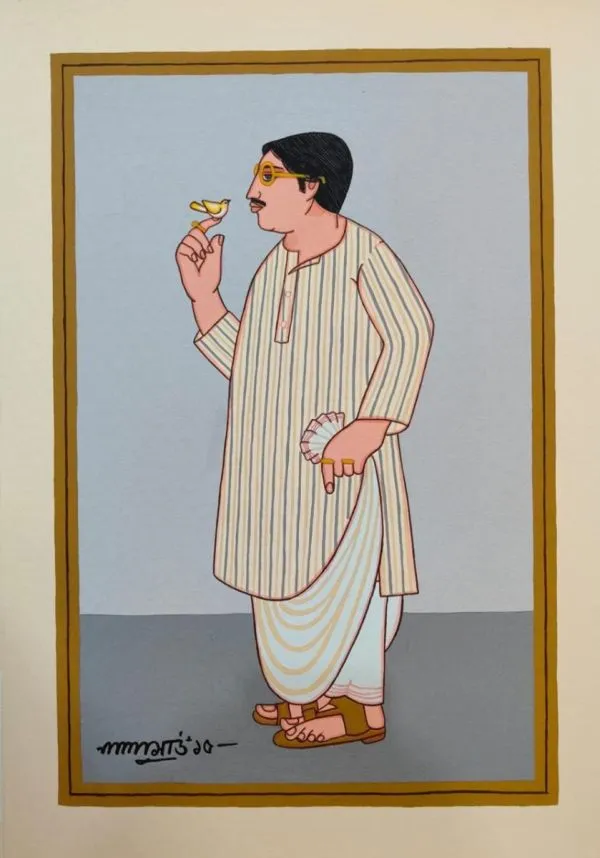
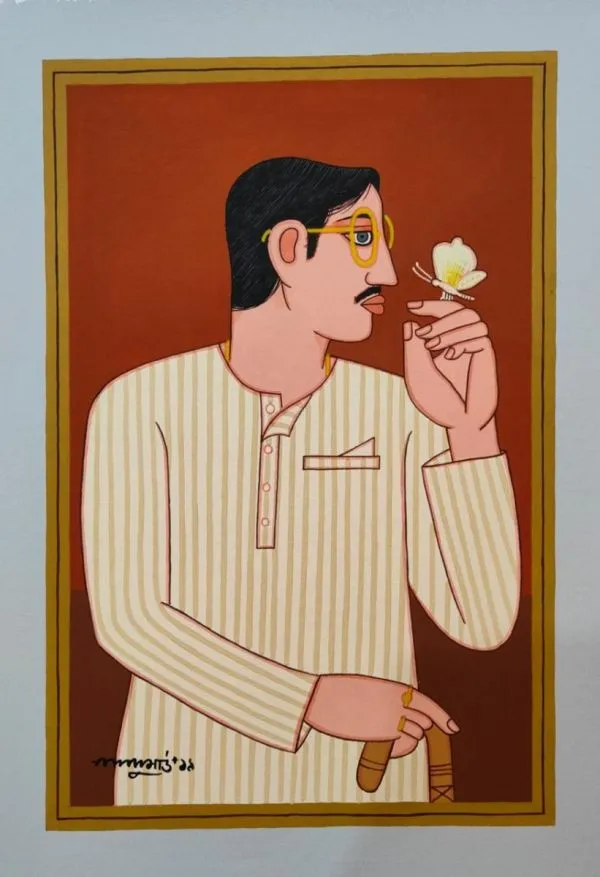
Bibi by Lalu Prasad Shaw.
While teaching at Kala Bhavan, Shaw found his students copying the Lucknow Birds series, regional Mughal miniatures, and their influence led him to begin drawing birds and their movements. Many of his works are crowded with sunflowers and other bright flowers, giving them a strongly decorative surface, and he added a border reminiscent of Mughal miniatures. He also drew on the Kalighat patas, and on the Babu culture they often depicted, treating this traditional subject matter with contemporary elements — themes he extended into the Babu and Bibis series of 2005. Shaw has consistently worked with straightforward subjects in a strictly two-dimensional style. His Babu series shows men and women of urban Calcutta engaged in feudal-style leisure, in an ambience that can be traced back to the Kalighat patas.
The geometric shapes and forms of his earlier work gave way to a greater flexibility and a kind of quiet drama, reinforced by his interest in Far Eastern art at Kala Bhavan.
Vinayak Pasricha.